
Brown County Owner Record Card
The Brown County Appraiser Public Parcel Search is the official starting point. It is where you find the owner of record. The Appraiser keeps parcel and sales data. Ownership changes recorded by the Register of Deeds flow into assessment and tax administration. Check the live card for its exact field labels and the record date shown. Field names can vary from one Kansas county to another. Treat any neighboring county's display as a poor guide.
| Displayed owner | The name used on the current assessment record |
|---|---|
| Mailing address | Where county notices are directed, not proof of occupancy |
| Situs address | The parcel's physical address when one is assigned |
| Parcel key | The stable link used to join map, value, and tax records |
| Legal description | The lot, block, addition, or rural land description |
| Record date | The date needed to judge whether the display may lag a transfer |
The official Appraiser page opens the county parcel route. It also names the office behind valuation and parcel data.
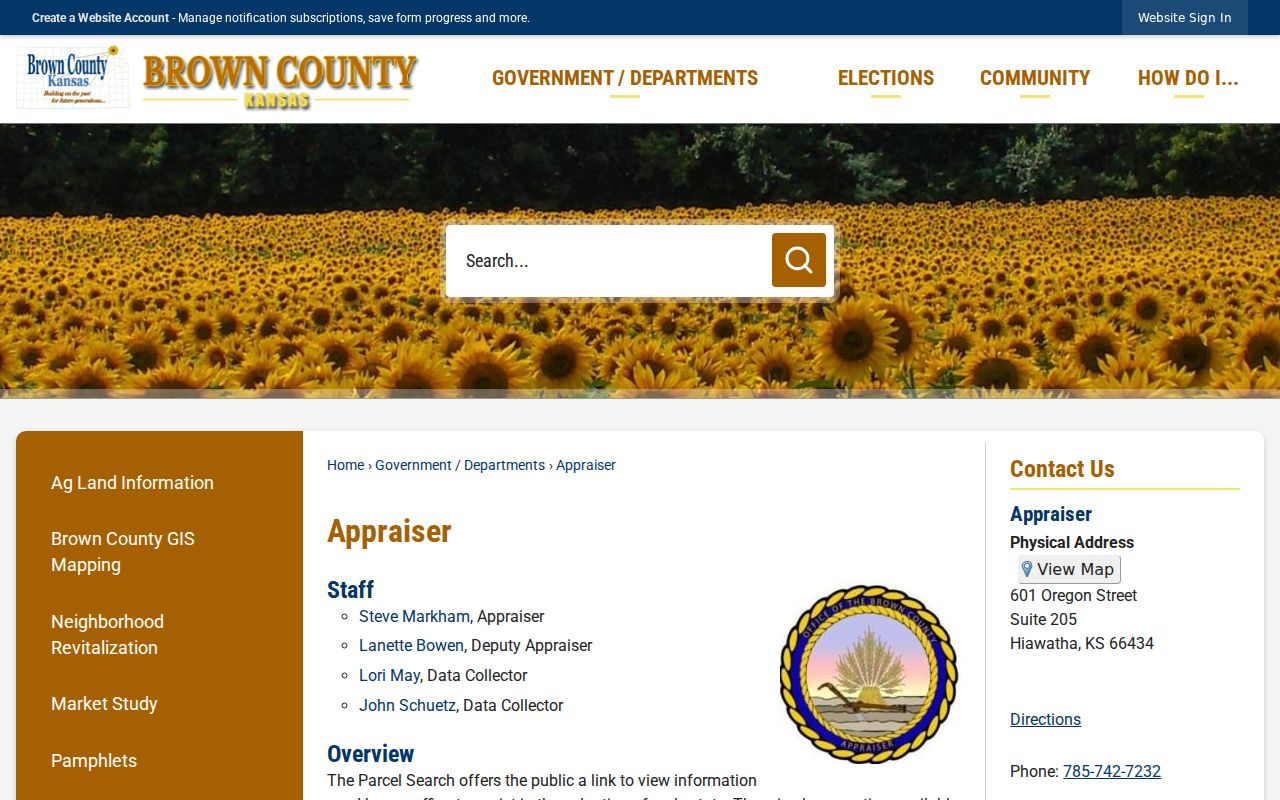
The office's own page is a dependable fallback when a parcel result will not load. An owner of record is not always the person on the land. So save the parcel key and legal description before checking any deed.
Date Brown County Owner Evidence
Every owner result deserves a date. Brown County describes how recorded ownership travels from the Register of Deeds to the Appraiser and then into the annual work of the Clerk and Treasurer. But it publishes no guaranteed update interval. A deed recorded yesterday may lag in a downstream parcel display. Record the date you searched, the parcel number, the displayed owner, and the legal description.
Source dating matters right now. County commission minutes note an Acting Register appointment effective March 2026 after a vacancy. That staffing change does not invalidate anything. It does argue for using current office pages and dating every request. Portal access and staff assignments shift.
Separate Brown County Property Fields
A Brown County city parcel may carry a street address plus a lot, block, and named addition. Rural land leans on section, township, range, acreage, and tract wording. A mailing address and a situs address can differ without any error. The legal description remains the best cross-office control. It follows the land better than any postal label.
Street wording also drifts over time. Hiawatha records may use Oregon Street or streets named for tribal nations, and Everest's older materials may say Eyerton. Use those clues to find a record, but let the current parcel and its legal description settle the match.
Verify Brown County's Latest Conveyance
The Brown County Register of Deeds keeps the title history. Its counter holds land records from 1857 forward. Deeds, mortgages, releases, assignments, plats, surveys, liens, and powers of attorney all belong to that archive. Every one of them sits in the office's holdings. The office publishes no dependable online grantor-grantee index. So verification may take a counter visit or a precise written request to the Register at 601 Oregon Street, Suite 206, Hiawatha. The phone number is 785-742-3741 during listed weekday hours.
Ask for the newest recorded conveyance touching the exact legal description. Read the grantee, the party receiving the interest, and the grantor, the party conveying it. Note the execution date, the recording date, and any prior-instrument reference. Vesting describes how the grantee's title is stated. The deed's own language controls that point, never a mailing label.
For a record held elsewhere, Brown County publishes a Kansas Open Records Act request form. KORA does not force an office to create a new record. It does not require an assembled chain-of-title study either. So describe the parcel and the specific document you need.
Check Brown County Entity Owners
A parcel may list an LLC, corporation, trust, or estate instead of a person. For a Kansas business entity, search the Secretary of State Business Entity Search by business name, Kansas Business ID, or resident agent. Name modes include “Contains” and “Starts With.” Results stop at the first 200. Sole proprietorships, assumed names, and DBAs never file there.
A registered agent receives official papers for an entity. The agent is not automatically the property owner. A trust name may send you back to the deed. The deed identifies the trustee and capacity. An estate transfer can require a probate order, executor's deed, or other recorded instrument. The assessment name catches up only after that recording.
Distinguish Leads From Brown County Transfers
A foreclosure filing, probate case, delinquent-tax notice, or city permit can connect a person to land. None of them alone proves ownership changed. The Kansas District Court Public Access Portal adds party and case-event context. It covers foreclosure, quiet-title, and probate matters. Its display is not the official court record, and redactions apply.
Spring 2026 tax-sale materials show the timing trap. A notice can list an owner, tract, costs, and legal description. But the county warns that the day-of-sale list controls. Notice, sale, redemption status, confirmation, and deed are separate events. The latest recorded deed remains the true ownership test.
Confirm Brown County Ownership Now
When ownership details will drive a purchase, a boundary talk, or an estate task, verify the name through a controlled check. Each step in the chain tests a different part of the Brown County property records result.
- Locate the parcel in the Appraiser public search and record the date, parcel key, owner label, and legal description.
- Request the most recent conveyance from the Register and match its legal description to the parcel.
- Read the grantee and vesting language; if an entity appears, check the Kansas business filing or the deed's trustee wording.
- Review later releases, court orders, or estate instruments that could affect the current state of title.
- Owner of record
- The party named in the selected official record.
- Vesting
- The form in which the deed states that title is held.
- Tenancy
- The legal relationship among co-owners when the instrument states one.
- Registered agent
- An entity's official contact, who is not necessarily its owner.
When Brown County Search Fails
The county's parcel application shows both a login panel and a public-search route on its landing page. The public search is not always reliable, though. Fall back on the Appraiser office. It sits at 601 Oregon Street, Suite 205, Hiawatha, or call 785-742-7232. Have the address ready. A parcel number helps, and so does a legal description. Be clear about which field or record you need.
Questions about the newest deed belong with the Register of Deeds. For older context, the Kansas Historical Society keeps Brown County deed and mortgage index material. The Brown County Genealogical Society holds tax rolls, probate files, obituaries, and newspapers. Those collections can explain how a name changed hands. They should not replace current official property records, though, as evidence of who owns a parcel today.
Contact a Brown County Owner Lawfully
A mailing address in the public record can be a fair way to reach an owner of record. It can support a property-specific letter. Handle it with care. Kansas Safe at Home gives eligible survivors a substitute legal address with mail forwarding. A public address may exist to shield someone's real location. KORA exemptions and other laws may allow redaction of that field from county property records.
Lawful use. Use Brown County owner information only for legitimate property and civic purposes. Kansas law prohibits stalking, harassment, threats, and unlawful invasions of privacy.