
Brown County Deed Records
The Register of Deeds handles far more than deeds. Mortgages, releases, assignments, plats, surveys, liens, easements, powers of attorney, cemetery deeds, and mineral instruments all pass through the office. Labels narrow the hunt, but the recorded text and its legal description reveal which interest a Brown County deed truly affects.
| Deed Type | What It Does | Common Use |
|---|---|---|
| Warranty deed | Conveys the described interest with stated promises | Sale or family transfer |
| Quitclaim deed | Transfers whatever interest the grantor may hold | Release or cleanup |
| Correction deed | Corrects a stated error in an earlier instrument | Name or description repair |
| Trustee / executor deed | Conveys under trust or estate authority | Trust or inherited land |
| Tax deed | Records conveyance after a completed tax process | Tax proceeding |
Mortgages and liens burden an interest. They do not transfer ownership. When you search Brown County deed records, pull the releases and assignments too, because a later filing does not always clear an earlier claim.
Brown County Grantor-Grantee Chain
Brown County keeps deep land records. The Brown County Register of Deeds dates them to 1857. No stable public web index exists. The dependable routes are the public counter, the phone, and a focused written request to Suite 206 at 601 Oregon Street in Hiawatha, open weekdays from 8:00 a.m. to 4:30 p.m.
- Locate the newest purchase deed with the known party indexed as grantee.
- Copy its grantor, date, deed type, citation, and full legal description.
- Search that grantor as a grantee in the earlier period.
- Use the numerical index to cross-check every instrument affecting the same tract.
- Grantor
- The party conveying the stated property interest.
- Grantee
- The party receiving that interest.
- Chain of title
- The linked sequence of recorded transfers.
- Book/Page vs Instrument #
- Two ways to cite an exact recorded filing.
Brown County Deeds Since 1857
Brown County was established in 1855. Its land records begin barely two years later. A genealogy packet traces one tract, SW/4 SE/4, Section 10, Township 2, Range 15, from Albert Lewis to E. Smith by warranty deed in 1887 at Book 57, Page 489. A second deed moves it from E. Smith to Herbert Jenkins in 1901 at Book 60, Page 125. That shared land description is the thread tying the two deeds together.
The Kansas Historical Society holds useful finding aids. Its lists cover grantor and grantee indexes for 1858 through 1905. Numerical indexes run through 1913, and mortgage records span the same years. They mark archive series, not the end of Brown County deed records. The KSHS ownership-map guide adds historical context.
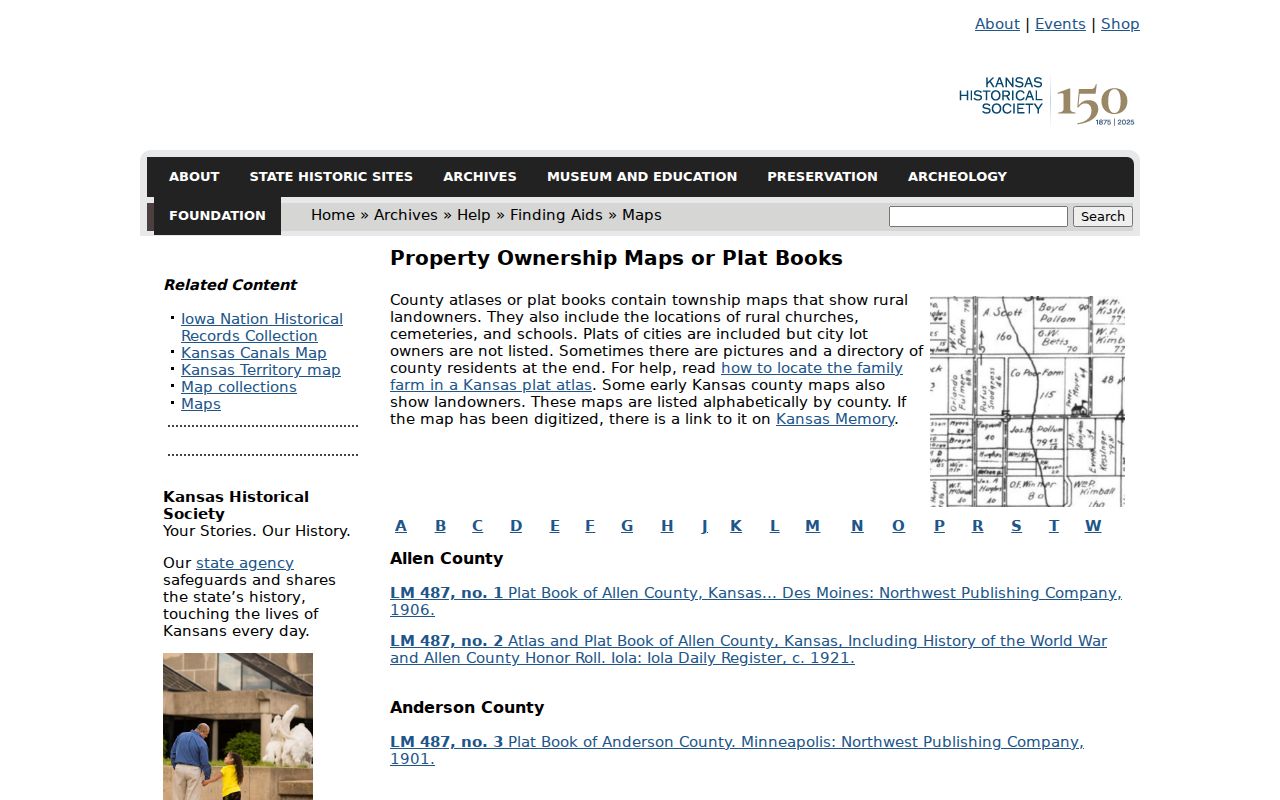
Historic maps can orient an old tract. They never replace the recorded deed or a fresh legal survey.
Prepare Brown County Deed Filings
Recording starts with an original instrument that names the first and second parties when required. Signatures need printed names beneath them. Notarization must be valid, with complete details for any out-of-state notary. The land description has to be right, and a missing printed name draws a one-dollar penalty in Brown County.
A transfer for consideration generally needs a Kansas Sales Validation Questionnaire unless an exemption applies. K.S.A. 79-1437e lists the exceptions. K.S.A. 28-115 sets the recording-fee baseline, with seventeen dollars for a first page and thirteen dollars for each later page on many instruments. Technology and document-specific fees can shift the total.
Cross-Check Brown County Deeds
Trace mortgage assignments before hunting a release under the newest lender's name. Then match every release to the original mortgage citation and land description. Federal and state tax liens can burden the tract. So can material liens, mineral reservations, rights-of-way, plats, and surveys.
City requests need the exact addition, block, and lot. Horton sources use Original Town, C.K.&N., Kansas City, and West Horton. Rural descriptions keep section, township, range, and quarter fractions. An address alone can miss older index entries.
The official Register of Deeds page identifies the records desk.
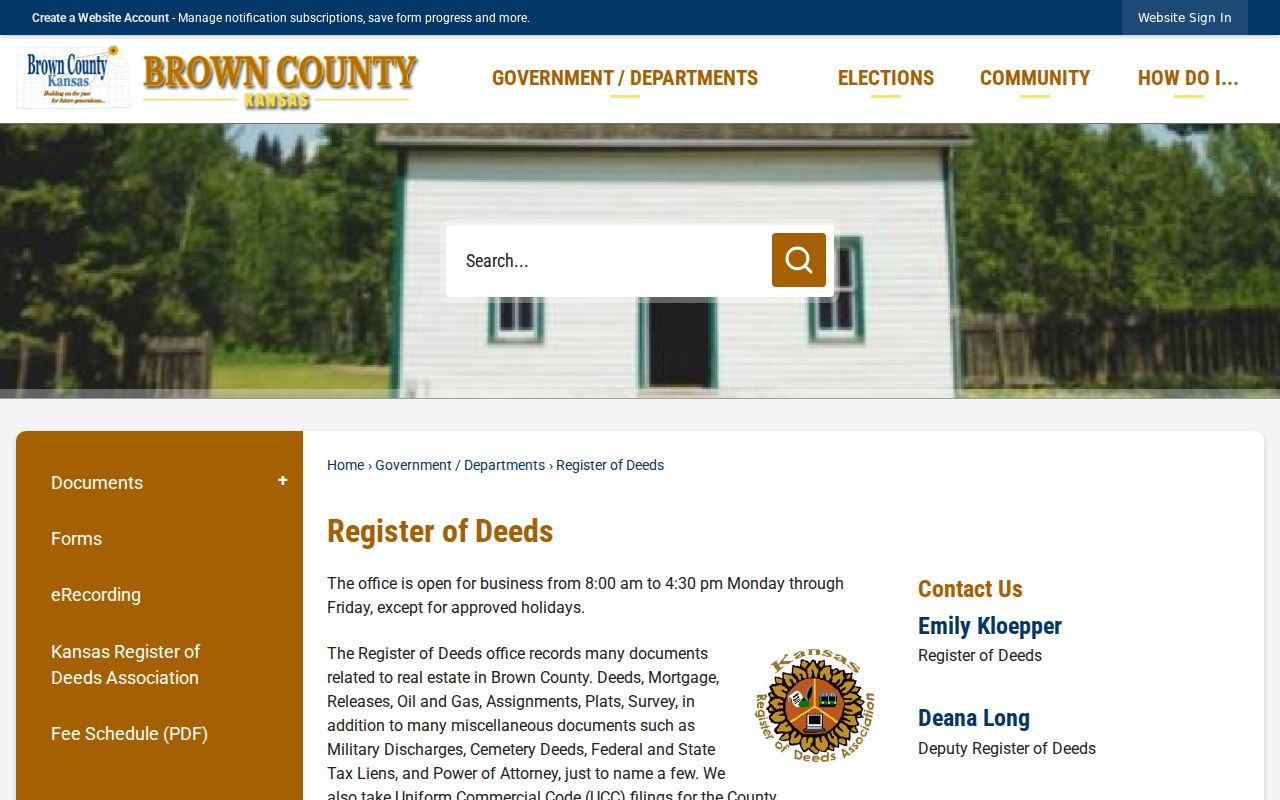
Confirm current copy options and availability before a visit.
Legal Descriptions in Brown Deeds
Legal descriptions matter more than street addresses here. A city deed cites an addition, block, and lot. A rural deed uses section, township, range, and quarter sections. Copy the fractions and punctuation exactly. Then compare that same description across the name index and the numerical index to confirm the match.
Plat requests need specifics. Name the subdivision or addition, the city or township, the block, and the lot, and say whether you want an original plat, a replat, an amendment, a dedication, a vacation, or a correction. A current parcel outline omits past plat acts. When a parcel was split or combined, follow the referenced prior instrument and the parent description before assuming continuity.
Horton's railroad-era additions show why precision pays. Original Town of Horton, C.K.&N. Addition, Kansas City Addition, and West Horton Addition still appear in current legal notices, and West Horton even has a lettered Block F example. Copy the plat wording as recorded rather than swapping in a modern neighborhood label.
Brown County Deed Access Channels
The Register of Deeds counter is the main way to reach Brown County deed records. A dependable online index has not surfaced, so plan on visiting in person. Call 785-742-3741 first to confirm hours. Ask which books are available. Ask how the office wants requests and payment. Keep written requests specific. Request a particular index entry or recorded document. Do not ask for a full family or title-chain search.
Older Brown County land work has other avenues. The Kansas Historical Society keeps microfilm finding aids. Morrill Public Library and the Brown County Genealogical Society hold newspapers. They also keep tax rolls, probate files, obituaries, and other county material. A newspaper or atlas item can surface a name or a date. It may even give an old place label. That can sharpen the deed search. Treat it as a lead, not proof of a conveyance.
Dates matter here. Brown County commission minutes recorded an Acting Register appointment effective March 2026 after a vacancy. Confirm who currently holds the office before you travel. Note the date any access details came from staff or the office page.
Request a Brown County Deed
Give the Register the grantor and grantee names, an approximate date, and the instrument type. Include the full legal description. A known book and page helps too. Staff will not run a chain search for a researcher. Brown County's written records form lets you pick a delivery method, but KORA does not force the county to build a new report or settle a title question. Request a cost estimate before copies are made.
Recorded, not guaranteed. Brown County deed records provide public notice, but they do not guarantee clear title or resolve unrecorded claims.
Make Brown County Deed Requests Precise
A request for everything on a property invites delay and extra fees. Narrow it down. Name a specific record set, such as deeds, mortgages, releases, assignments, plats, surveys, or lien notices. Tie the request to one party or legal description within a date range. The index may return a long list. Ask to inspect the entries before anything is copied.
Brown County's Open Records Request form asks for your contact information, a description of the record, and the intended use. It also asks for a delivery choice and an acknowledgment of charges. The form states the Kansas restriction on using lists of names and addresses. You may not use them to sell or solicit property or services. A parcel-specific title-history request differs from a bulk list request. The lawful-use terms apply either way.
Under Kansas Open Records Act guidance, an agency may charge actual costs and require prepayment. The county form lists page charges along with hourly research, compilation, typing, and printing fees. Ask for an estimate and trim the request before copying starts. If a record holds exempt content, request the releasable portion. Ask for a citation for whatever is withheld.
Older names call for different tools. The Brown County Genealogical Society and Morrill Public Library offer newspapers and local-history leads. Register staff can walk you through their index and copying process. However, the genealogy packet notes they will not perform the chain search. Arrive with a working list of surnames, spelling variants, dates, citations, and exact land descriptions.